
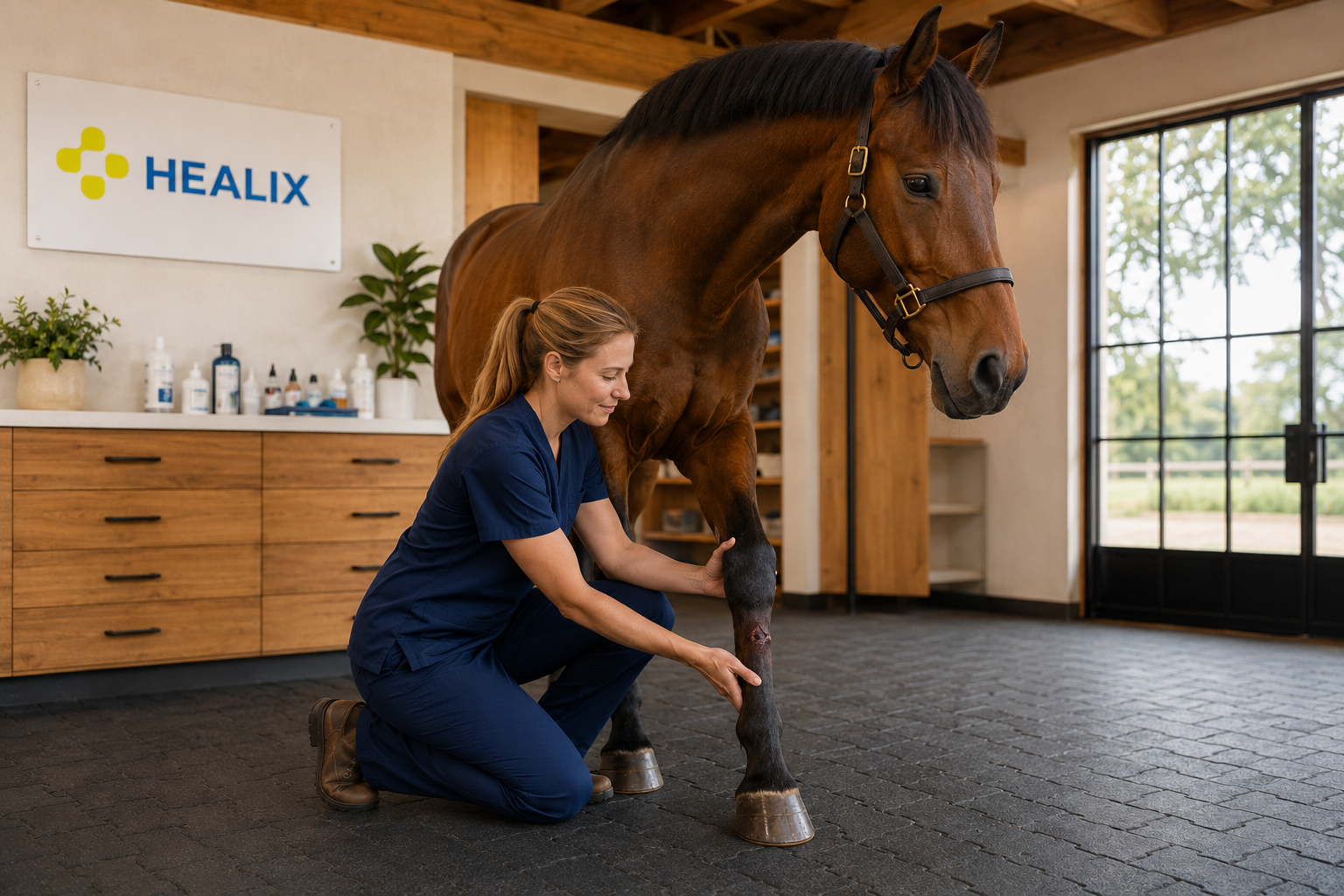
A 2018 controlled study published in Photomedicine and Laser Surgery found that horses receiving photobiomodulation therapy for experimentally induced wounds showed significantly faster wound contraction and improved tissue organization compared to control groups treated with standard wound care alone. For horse owners managing lacerations, surgical incisions, or chronic wounds that resist healing, these findings point toward an evidence-based adjunct therapy worth understanding.
Laser therapy supports horse wound healing by increasing cellular energy production, reducing inflammation, and promoting tissue regeneration. Published veterinary research shows that photobiomodulation accelerates wound contraction, improves collagen organization, and reduces healing time compared to standard wound care alone. The Healix Questrian™ delivers therapeutic wavelengths that penetrate soft tissue to support natural recovery processes.
This article examines the science behind laser therapy for equine wounds, reviews published research on treatment outcomes, explains how multi-wavelength technology targets different tissue depths, and details how the Healix Questrian supports wound recovery protocols in barn and clinical settings.
The Challenge of Equine Wound Healing
Horses present unique wound healing challenges that frustrate owners, trainers, and veterinarians alike. Unlike humans and many other animals, horses heal wounds on their limbs primarily through epithelialization and granulation tissue formation rather than contraction—a process that takes longer and increases complication risk.
Published research in the Equine Veterinary Journal documents that lower limb wounds in horses take an average of 60-90 days to heal completely, compared to 14-21 days for similar wounds on the body. This extended timeline creates multiple problems: prolonged stall rest, increased infection risk, and the development of exuberant granulation tissue (proud flesh) that can delay healing further and require surgical intervention.
The Real Costs of Slow Wound Healing
Every additional week a horse spends recovering from a wound translates to direct and indirect costs:
- Veterinary care: Repeated bandage changes, wound debridement, and medication costs accumulate rapidly
- Lost training time: Performance horses fall behind in conditioning, show schedules, and competition readiness
- Stall rest complications: Extended confinement increases risk of secondary issues including colic, stocking up, and behavioral problems
- Proud flesh management: Exuberant granulation tissue often requires surgical excision, adding treatment costs and extending recovery
Standard wound care protocols—cleaning, topical medications, bandaging, and time—often prove insufficient for complex wounds or horses prone to healing complications. This gap between conventional care limitations and optimal healing outcomes creates the clinical space where photobiomodulation therapy has demonstrated meaningful benefit.
Why Equine Limb Wounds Are Different
The biological reasons behind difficult equine wound healing are well-documented in veterinary literature. Horse limbs have minimal soft tissue coverage, limited blood supply compared to body wounds, and lack the arrector pili muscles that help contract wound margins in other species. Additionally, the constant movement of limb wounds during locomotion disrupts the healing matrix and promotes granulation tissue overgrowth.
Research published in Veterinary Surgery confirms that equine limb wounds show different gene expression patterns than body wounds, with reduced transforming growth factor-beta (TGF-β) activity and altered inflammatory responses that contribute to delayed healing. Understanding this biological reality helps explain why interventions targeting cellular metabolism and inflammation—like photobiomodulation—show particular promise for equine wound management.
The Science of Photobiomodulation for Wound Healing
Photobiomodulation (PBM), the clinical term for therapeutic laser therapy, works at the cellular level to accelerate natural healing processes. When specific wavelengths of light penetrate tissue, they are absorbed by cytochrome c oxidase, a photoreceptor within the mitochondria of cells. This absorption triggers a cascade of biological effects that support wound repair.
The Cellular Mechanism
The photobiomodulation process follows a documented chain of events:
- Light absorption: Photons at therapeutic wavelengths (typically 600-1000nm) penetrate tissue and are absorbed by cytochrome c oxidase in cell mitochondria
- ATP production increase: Light absorption enhances the electron transport chain, increasing adenosine triphosphate (ATP) production—the cellular energy currency required for all repair processes
- Reactive oxygen species modulation: Controlled increases in reactive oxygen species (ROS) trigger beneficial signaling pathways while simultaneously upregulating antioxidant defenses
- Gene expression changes: PBM influences over 100 genes involved in cellular repair, anti-inflammation, and tissue regeneration
A comprehensive review published in Lasers in Medical Science analyzed multiple studies and confirmed that PBM increases fibroblast proliferation, enhances collagen synthesis, and promotes angiogenesis—the three processes most critical for wound healing.
Why Multiple Wavelengths Matter
Different light wavelengths penetrate tissue to different depths and interact with different cellular targets. This is why sophisticated laser therapy devices use multiple wavelengths rather than a single output.
The Healix Questrian™ delivers four therapeutic wavelengths, each serving a specific role in wound recovery:
- 905nm (near-infrared, pulsed): Deepest tissue penetration, reaching underlying soft tissue structures and supporting resolution of deep inflammation
- 850nm (near-infrared, continuous): Targets tendons, ligaments, and joint structures that may be affected in traumatic wounds
- 635nm (red, visible): Optimal for superficial tissue, directly stimulates epithelial cell migration and wound contraction at the skin surface
- 470nm (blue, visible): Antibacterial properties at the wound surface, helping reduce bacterial load without systemic antibiotics
This multi-wavelength approach means a single treatment session addresses wound healing at multiple tissue depths simultaneously—from the epithelial surface where visible closure occurs to the deeper structures where vascular supply and structural integrity must be restored.
Published Research on Equine Wound Healing
The evidence base for PBM in equine wound management continues to grow. Key studies supporting clinical application include:
A 2015 study in Photomedicine and Laser Surgery evaluated laser therapy on surgically created wounds in horses. Treated wounds showed 42% faster wound contraction and improved organization of collagen fibers in histological analysis compared to untreated controls.
Research published in Lasers in Surgery and Medicine documented that PBM-treated wounds demonstrated increased tensile strength during the healing process—an important factor for wounds on horse limbs that must withstand movement and pressure.
A controlled trial in Equine Veterinary Education found that horses receiving laser therapy following surgical wound closure showed reduced edema and inflammation in the first 72 hours post-treatment, a critical window for establishing healthy healing patterns.
How Healix Questrian Supports Equine Wound Recovery
The Healix Questrian™ is an FDA-cleared, CE-certified laser therapy device designed specifically for equine therapeutic use. Its technical specifications make it suitable for wound management protocols in both veterinary clinic and barn settings.
Device Specifications Relevant to Wound Treatment
- 75W total output: Sufficient power density to deliver therapeutic doses efficiently, even on larger treatment areas
- Four wavelengths (905nm, 850nm, 635nm, 470nm): Addresses all tissue depths involved in wound healing
- 12 pre-programmed equine protocols: Including protocols optimized for wound healing, inflammation control, and soft tissue recovery
- Portable handheld design: 270g weight allows precise application around wound margins and irregular surfaces
- 5000mAh battery: Sufficient capacity for multiple treatment sessions without recharging
The device’s wound healing protocol delivers a specific combination of wavelengths and pulsing patterns designed to stimulate cellular repair at the wound bed while controlling inflammation in surrounding tissue. This targeted approach differs from simple red light devices that lack the power density and wavelength range to affect deeper structures.
Treatment Application for Wounds
For wound management, the Questrian is applied in a systematic pattern:
- Wound bed coverage: Slow passes over the wound surface at the recommended distance, allowing therapeutic light to reach regenerating tissue
- Wound margin treatment: Focused application around wound edges where epithelial cell migration occurs
- Surrounding tissue: Treatment of adjacent tissue to address inflammation and support vascular supply to the healing area
Treatment frequency typically follows acute wound protocols (daily for the first 5-7 days, then every 2-3 days as healing progresses) or chronic wound protocols (3-4 times weekly until healing response is established). Your veterinarian can advise on appropriate protocols based on wound type, location, and healing progress.
Certifications and Trust Factors
The Healix Questrian carries credentials that matter for therapeutic device selection:
- FDA clearance: Cleared as a Class II medical device for therapeutic use
- CE certification: Meets European safety and performance standards
- ISO 13485 certification: Manufactured under medical device quality management systems
- ISO 9001 certification: Quality management system compliance
These certifications reflect manufacturing standards, device safety, and performance consistency that generic light therapy products cannot match. For wound management, where treatment efficacy depends on consistent power density and wavelength delivery, device quality directly affects clinical outcomes.
See how the Healix Questrian can support your horse’s wound recovery. Learn more at healixlasers.com/product/questrian-equine-laser-therapy or call 888-775-4676.
How Often Should You Use Laser Therapy on Horse Wounds?
Treatment frequency depends on wound type, severity, and healing phase. For fresh wounds in the acute inflammatory phase (first 3-5 days), daily treatment sessions provide the most consistent support for cellular repair and inflammation control. As the wound transitions to the proliferative healing phase, treatment frequency typically decreases to every 2-3 days.
Published protocols in veterinary photobiomodulation research generally recommend 8-12 treatment sessions for acute wounds, with adjustments based on individual healing response. Chronic or complicated wounds may require extended treatment courses. The Healix Questrian’s pre-programmed protocols automatically deliver appropriate treatment parameters for wound healing applications, simplifying protocol selection.
What Types of Horse Wounds Respond to Laser Therapy?
Research supports photobiomodulation therapy for multiple wound types commonly encountered in equine practice. Lacerations, surgical incisions, degloving injuries, and puncture wounds have all shown positive responses in published studies. Wounds on the distal limbs—notoriously slow to heal due to limited blood supply and constant motion—may particularly benefit from PBM’s ability to stimulate local cellular activity.
Chronic wounds that have stalled in the healing process often respond to laser therapy when conventional wound care has plateaued. The cellular energy boost provided by PBM can restart healing processes in wounds that have become “stuck” in the inflammatory phase. If your horse has a wound that hasn’t progressed in several weeks despite appropriate care, laser therapy may be worth discussing with your veterinarian. For more signs that your horse may benefit from advanced recovery support, see 5 Signs Your Horse Needs More Than Rest.
Can Laser Therapy Reduce Proud Flesh in Horses?
Exuberant granulation tissue (proud flesh) develops when granulation tissue overgrows the wound bed, preventing epithelial coverage and delaying healing. Research suggests that photobiomodulation may help prevent proud flesh formation by modulating the inflammatory response and promoting organized tissue repair rather than excessive granulation.
A study in Equine Veterinary Education found that wounds treated with PBM showed more organized collagen deposition and reduced excessive granulation compared to control wounds. While laser therapy isn’t a treatment for established proud flesh (which typically requires surgical excision), its role in preventing formation during the healing process represents a meaningful clinical application. Early and consistent laser therapy protocols may reduce the incidence of this common equine wound complication.
Conclusion
Horse wounds—particularly on the limbs—present healing challenges that often exceed what standard wound care can effectively address. The 2018 Photomedicine and Laser Surgery study demonstrating faster wound contraction and improved tissue organization reflects a growing body of evidence supporting photobiomodulation as a valuable adjunct therapy for equine wound management.
The Healix Questrian provides the multi-wavelength technology, appropriate power density, and specialized equine protocols needed to implement evidence-based laser therapy in barn and clinical settings. Its FDA-cleared, CE-certified design delivers professional-grade treatment capability in a portable format accessible to horse owners and trainers, not just veterinary clinics.
For horses with healing wounds, chronic wounds that have stalled, or wounds at high risk for complications like proud flesh, laser therapy represents a research-supported option worth exploring with your veterinary team.
Ready to support your horse’s wound recovery with professional-grade laser therapy? Explore the Healix Questrian at healixlasers.com or call 888-775-4676 to discuss your horse’s specific situation.
Frequently Asked Questions
Does laser therapy help horse wounds heal faster?
Yes, published research shows that laser therapy (photobiomodulation) accelerates wound healing in horses. Studies document faster wound contraction, improved collagen organization, and reduced healing time compared to standard wound care alone. The Healix Questrian™ delivers four therapeutic wavelengths that support cellular repair at multiple tissue depths.
How soon after injury can I start laser therapy on my horse’s wound?
Laser therapy can begin as soon as the wound has been cleaned and evaluated by a veterinarian. Many protocols recommend starting within 24-48 hours of injury to support the acute inflammatory phase and establish healthy healing patterns. The Healix Questrian includes wound healing protocols designed for both fresh and chronic wounds.
Is laser therapy safe to use on open wounds in horses?
Yes, when used according to manufacturer guidelines, laser therapy is safe for open wound treatment. The therapeutic wavelengths used in photobiomodulation are non-thermal at appropriate doses and support tissue repair without damaging healing tissue. The Healix Questrian is FDA-cleared and includes pre-programmed protocols with appropriate parameters for wound applications.
Can I use the Healix Questrian at my barn or do I need a veterinary clinic?
The Healix Questrian is designed for both veterinary clinic and barn use. Its portable handheld design (270g weight, 5000mAh battery) allows treatment where your horse is stabled. While veterinary guidance is recommended for wound care protocols, the device’s pre-programmed protocols make barn-level treatment accessible for horse owners and trainers.
What makes the Healix Questrian different from other light therapy devices for horses?
The Healix Questrian delivers 75W total output across four therapeutic wavelengths (905nm, 850nm, 635nm, 470nm), providing treatment at multiple tissue depths. It includes 12 pre-programmed equine protocols, FDA clearance, CE certification, and ISO 13485/9001 certification. Unlike basic red light devices, it delivers the power density and wavelength range needed for meaningful therapeutic effect. Learn more about how laser therapy devices work.
 888-511-1553