
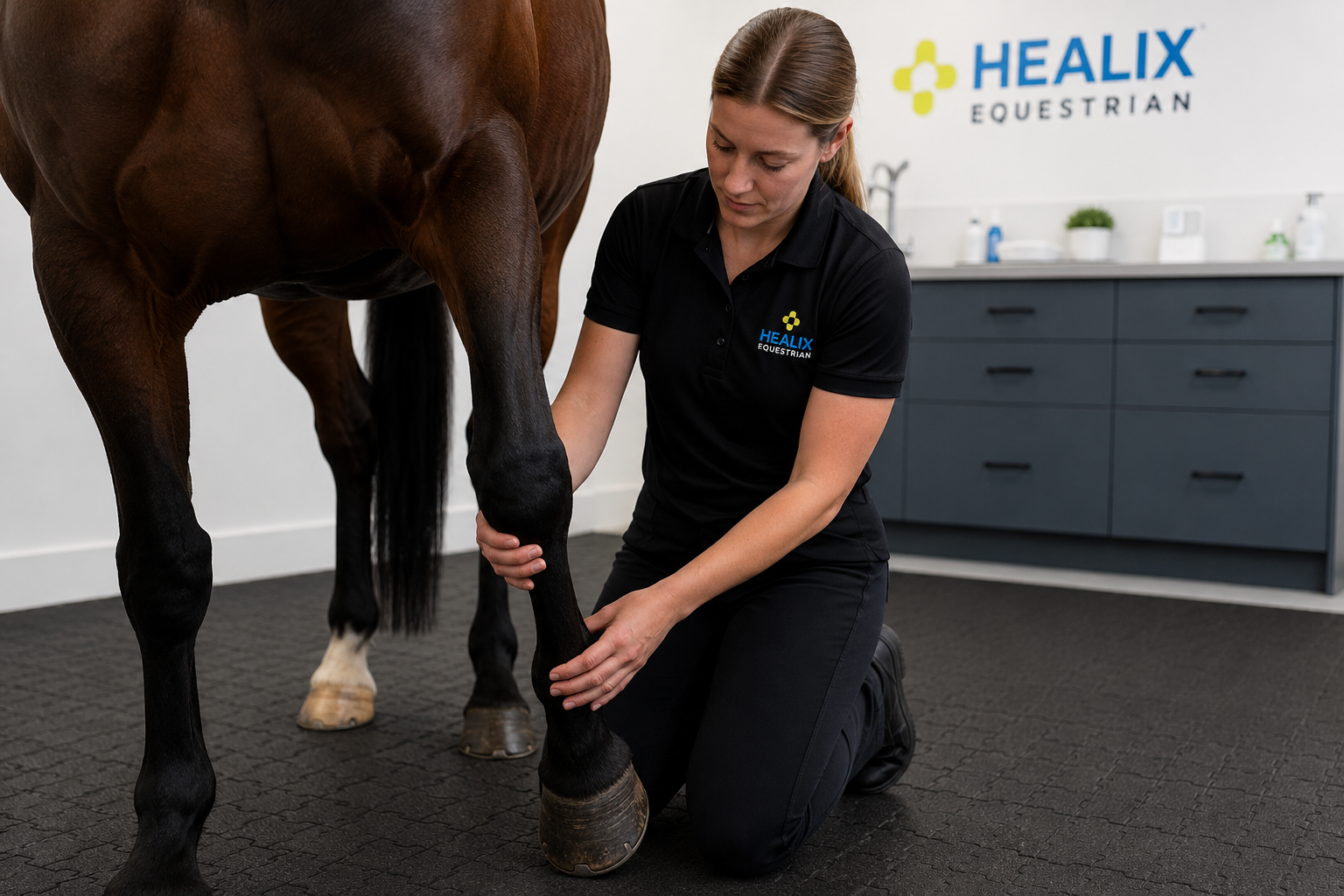
A controlled study published in Frontiers in Veterinary Science in 2020 tracked 12 Warmblood horses with induced superficial digital flexor tendon lesions, finding that horses receiving high-power laser therapy showed significantly smaller lesion sizes on ultrasound examination compared to untreated controls. This research joins a growing body of veterinary evidence demonstrating that photobiomodulation—the scientific term for therapeutic laser treatment—produces measurable biological changes in equine tissue.
Equine laser therapy delivers measurable benefits including accelerated tissue repair, reduced inflammation, and faster return to work. Published veterinary research shows treated horses demonstrate significantly smaller lesion sizes and improved healing compared to control groups, with some studies documenting return to competition in as little as six months following soft tissue injury.
For horse owners, trainers, and equine veterinarians weighing treatment options, understanding the documented benefits of equine laser therapy requires looking beyond marketing claims to the published research. This article examines what peer-reviewed veterinary studies actually show about laser therapy’s effects on horses, explains the biological mechanisms that produce those effects, and clarifies how professional-grade devices like the Healix Questrian™ translate research findings into practical barn-level treatment.
The Challenge of Equine Soft Tissue Recovery
Soft tissue injuries remain the leading cause of lost training days and premature retirement in performance horses. Tendon and ligament damage—particularly to the superficial digital flexor tendon (SDFT) and suspensory ligament—presents a recovery challenge that conventional approaches often fail to adequately address.
The biology of tendon healing explains why. Unlike bone, which typically heals with tissue nearly identical to the original structure, tendons heal through scar tissue formation. This scar tissue lacks the organized collagen fiber arrangement of healthy tendon, resulting in reduced elasticity and increased re-injury risk.
Published research documents the scope of this problem. A retrospective study of 150 sport horses treated between 2012 and 2019, published by Pluim and colleagues, found that tendon and ligament injuries accounted for a substantial portion of cases requiring extended rehabilitation. The same research documented that untreated or inadequately treated horses faced recurrence rates that effectively ended competitive careers.
The financial implications compound the clinical concern. As detailed in The Real Cost of Slow Recovery in Performance Horses, extended layup periods carry costs far beyond veterinary bills. Training fees continue during downtime. Competition entry fees and potential earnings disappear. Insurance premiums rise following injury claims. For many owners, the question isn’t whether to invest in accelerated recovery—it’s which approaches actually deliver results.
Traditional treatment protocols center on controlled exercise programs and anti-inflammatory medications. While these approaches remain foundational, they address symptoms without directly enhancing the cellular repair processes that determine healing quality. This gap in treatment options has driven growing interest in therapies that work at the cellular level—including photobiomodulation.
The Science of Photobiomodulation in Horses
Understanding the benefits of equine laser therapy requires examining the biological mechanism that produces those benefits. Photobiomodulation (PBM)—formerly called low-level laser therapy—describes the process by which specific wavelengths of light energy trigger measurable changes in cellular function.
The mechanism begins at the mitochondria, the cellular structures responsible for energy production. When photons at therapeutic wavelengths penetrate tissue and reach cells, they are absorbed by cytochrome c oxidase, a protein complex in the mitochondrial respiratory chain. This absorption triggers a cascade of cellular responses.
The Cellular Response Cascade
First, mitochondrial activity increases, resulting in elevated ATP (adenosine triphosphate) production—the molecule cells use as energy currency. Published research on PBM mechanisms, available through PubMed, documents that treated cells demonstrate measurably higher ATP concentrations than untreated cells.
Second, this energy increase enables accelerated protein synthesis, including the collagen production essential to tendon and ligament repair. Studies examining treated tendon tissue show improved collagen fiber organization compared to naturally healing tissue—a finding with direct implications for injury recurrence risk.
Third, PBM modulates inflammatory mediators. While acute inflammation serves necessary protective functions following injury, prolonged inflammation impedes healing. Laser therapy has been shown to shift the inflammatory response timeline, reducing chronic inflammation while preserving the beneficial acute response.
Why Wavelength Matters
Not all light wavelengths produce therapeutic effects, and different wavelengths penetrate to different tissue depths. This is why professional-grade equine laser devices use multiple wavelengths rather than single-wavelength systems.
- 905nm (near-infrared, pulsed) — Penetrates deepest into tissue, reaching the dense structures of tendons, ligaments, and joint capsules where many equine injuries occur
- 850nm (near-infrared, continuous) — Targets intermediate tissue depths, effective for muscle tissue and superficial tendon portions
- 635nm (visible red) — Absorbed by superficial tissues, supports wound healing and surface tissue repair
- 470nm (blue) — Addresses bacterial presence in open wounds, relevant for post-surgical treatment
The 2020 controlled study in Frontiers in Veterinary Science specifically used high-power multi-wavelength laser therapy, documenting that this approach produced measurable differences in lesion size and tissue organization compared to untreated controls.
Documented Benefits: What the Research Shows
The benefits of equine laser therapy are documented across multiple published studies examining different conditions, treatment protocols, and outcome measures. Rather than relying on anecdotal reports, horse owners and veterinarians can evaluate the therapy based on controlled research.
Accelerated Soft Tissue Repair
The Pluim retrospective study examining 150 sport horses treated between 2012 and 2019 found that horses receiving high-power laser therapy for superficial digital flexor tendon injuries achieved return to previous competition level within approximately six months—a timeline that compares favorably to historical expectations for conservative management alone.
The subsequent controlled study with 12 Warmbloods provided mechanistic confirmation: ultrasound examination at defined intervals showed treated horses had significantly smaller lesion cross-sectional areas than control horses, indicating enhanced tissue repair at the cellular level.
Reduced Inflammation and Pain
Multiple studies document laser therapy’s effects on inflammatory markers and pain behavior in horses. Research published in the Journal of Equine Veterinary Science has examined gait analysis and behavioral indicators following laser treatment, finding measurable improvements in movement quality consistent with reduced discomfort.
The anti-inflammatory effect relates directly to the cellular mechanism: PBM modulates the production of pro-inflammatory cytokines while supporting anti-inflammatory mediator release. For horses with acute injuries or chronic inflammatory conditions like arthritis, this biochemical shift translates to clinical improvement.
Improved Healing Quality
Perhaps most significant for long-term soundness, laser therapy appears to influence not just healing speed but healing quality. Histological examination of treated tendon tissue in research settings shows improved collagen fiber alignment compared to naturally healing tissue.
This finding addresses the core challenge of tendon repair: the scar tissue that replaces injured tendon is functionally inferior to original tissue, creating weakness at the injury site. If laser therapy can improve collagen organization during healing, the resulting tissue more closely resembles healthy tendon—potentially reducing re-injury risk.
Expanded Application Beyond Tendons
While soft tissue injuries drive much of the research interest, published studies document benefits across multiple equine conditions:
- Joint conditions — Osteoarthritis management, post-injection support
- Wound healing — Post-surgical sites, traumatic wounds, proud flesh prevention
- Back pain — Muscle tension, sacroiliac dysfunction
- Hoof conditions — Laminitis support, abscess recovery
The FEI recognizes laser therapy as a permitted treatment modality, reflecting its acceptance within competitive horse management.
How the Healix Questrian Delivers These Benefits
Translating research findings into practical treatment requires devices engineered to deliver therapeutic parameters consistently. The Healix Questrian™ was designed specifically to bring professional-grade laser therapy to barn-level use.
Technical Specifications That Matter
The Healix Questrian™ delivers 75 watts of total output power across four therapeutic wavelengths: 905nm, 850nm, 635nm, and 470nm. This multi-wavelength approach ensures treatment reaches tissue at multiple depths—from surface wounds to deep tendon structures.
The device includes 12 pre-programmed equine treatment protocols developed based on published research parameters. Protocols address specific conditions including:
- Tendon and ligament injuries
- Joint inflammation and arthritis
- Muscle soreness and strain
- Wound healing
- Back and sacroiliac conditions
Each protocol specifies appropriate power density, treatment duration, and pulse parameters for its target condition—removing guesswork from treatment delivery.
Design for Barn-Level Use
Research demonstrating laser therapy benefits was conducted in clinical settings, but treatment effectiveness depends on consistent application. The Questrian’s portable handheld design, weighing only 270 grams with a 5000mAh battery, enables treatment at the barn without requiring horses to ship to veterinary clinics.
For trainers and owners managing multiple horses or addressing conditions requiring frequent treatment, this accessibility transforms what’s practically achievable. The device’s FDA clearance, CE certification, and ISO 13485/9001 certification confirm it meets medical device standards while remaining accessible for non-clinical users.
Verified Outcomes
Horse owners using the Questrian report results consistent with published research findings. Users describe visible improvements in comfort and movement following treatment initiation, with some noting reduced swelling within the first week of consistent use.
For detailed information on recognizing when horses may benefit from laser therapy, see 5 Signs Your Horse Needs More Than Rest.
See how the Healix Questrian can support your horse’s recovery. Learn more at healixlasers.com/product/questrian-equine-laser-therapy or call 888-775-4676.
How Does Laser Therapy Work on Horses?
Laser therapy works by delivering specific wavelengths of light energy that penetrate tissue and trigger cellular responses. When photons reach cells, they are absorbed by cytochrome c oxidase in mitochondria, increasing ATP production and accelerating cellular repair processes. This mechanism has been documented in peer-reviewed research and explains why treated horses show measurable improvements in tissue healing compared to untreated controls.
The multi-wavelength approach used by devices like the Healix Questrian™ ensures treatment reaches different tissue depths, from surface structures to deep tendons and ligaments.
How Often Should Horses Receive Laser Therapy?
Treatment frequency depends on the condition being addressed and its severity. For acute soft tissue injuries, published protocols often recommend daily or every-other-day treatment during the initial inflammatory phase, transitioning to two to three sessions weekly as healing progresses. Chronic conditions may benefit from maintenance protocols of one to two treatments weekly.
The Questrian’s pre-programmed protocols provide guidance on treatment frequency for specific conditions. Consulting with an equine veterinarian helps establish an appropriate schedule for your horse’s individual situation. For more information on how laser therapy devices work, visit the Healix resource center.
Is Equine Laser Therapy FDA Cleared?
Yes, therapeutic laser devices including the Healix Questrian™ have received FDA clearance as Class II medical devices. This clearance indicates the device has met safety and effectiveness standards established by the FDA for therapeutic laser applications. The Questrian also holds CE certification for European markets and ISO 13485/9001 certification confirming quality management standards.
FDA clearance provides assurance that the device delivers the power output and wavelengths specified, producing the therapeutic parameters documented in published research.
Conclusion
The benefits of equine laser therapy are grounded in published veterinary research—from the cellular mechanisms of photobiomodulation to controlled studies documenting accelerated healing and improved tissue quality. For horse owners facing soft tissue injuries, the question is no longer whether laser therapy works, but how to implement it effectively.
The 2020 Frontiers in Veterinary Science study that opened this article demonstrated what’s possible: measurably smaller lesion sizes and improved healing in treated horses compared to controls. The Healix Questrian™ brings the technology behind those research outcomes to your barn, with 75W multi-wavelength output, 12 equine-specific protocols, and the portability to treat horses where they live and train.
To explore how professional-grade laser therapy can support your horse’s recovery and performance, visit healixlasers.com/product/questrian-equine-laser-therapy or call 888-775-4676.
Frequently Asked Questions
What are the main benefits of laser therapy for horses?
The main benefits include accelerated tissue repair, reduced inflammation, decreased pain, and improved healing quality. Published research shows treated horses demonstrate smaller lesion sizes on ultrasound and better collagen fiber organization in healed tissue, potentially reducing re-injury risk.
How long does it take to see results from equine laser therapy?
Many horse owners report visible improvements in comfort and reduced swelling within the first week of consistent treatment. For soft tissue injuries, the Pluim retrospective study documented return to competition level within approximately six months when laser therapy was part of the rehabilitation protocol.
Can I use laser therapy on my horse at home or do I need a veterinarian?
While veterinary diagnosis of the underlying condition is recommended, devices like the Healix Questrian™ are designed for barn-level use by owners and trainers. The pre-programmed protocols provide treatment parameters, making professional-grade therapy accessible outside clinical settings.
Is laser therapy safe for all horses?
Laser therapy has an excellent safety profile when used according to device guidelines. The Healix Questrian™ is FDA-cleared and CE-certified. Standard precautions include avoiding direct eye exposure and not treating over cancerous growths. Pregnant mares should be evaluated by a veterinarian before treatment.
What conditions can equine laser therapy treat?
Published research documents benefits for tendon and ligament injuries, joint conditions including osteoarthritis, muscle soreness, wound healing, back pain, and hoof conditions like laminitis support. The Healix Questrian™ includes 12 pre-programmed protocols addressing these common equine conditions.
This article is for informational purposes only and does not constitute veterinary advice. The information provided reflects published veterinary research on photobiomodulation and Healix Lasers’ product documentation. Treatment outcomes vary by horse, condition, and severity. Consult a licensed veterinarian before beginning any new therapy. The Healix Questrian™ is an FDA-cleared, CE-certified device designed for equine therapeutic use. For current product information, visit healixlasers.com or call 888-775-4676.
 888-511-1553