Every horse owner knows the frustration of a performance issue that won’t resolve with time off. According to equine veterinary research, approximately 60% of performance horses will experience lameness during their competitive careers, and rest alone proves insufficient for many underlying conditions. Recognizing the difference between fatigue requiring recovery time and problems needing active intervention can mean the difference between a minor setback and a career-ending injury.
This comprehensive guide reveals five critical warning signs that indicate your horse needs more than stall rest, backed by veterinary research and modern therapeutic approaches that support natural healing processes.
Understanding Why Rest Isn’t Always the Answer
Traditional equine medicine has long relied on the principle of rest, ice, compression, and elevation for managing injuries and performance issues. While rest remains essential for many conditions, modern understanding of equine physiology reveals that controlled therapeutic intervention often supports better outcomes than passive rest alone.
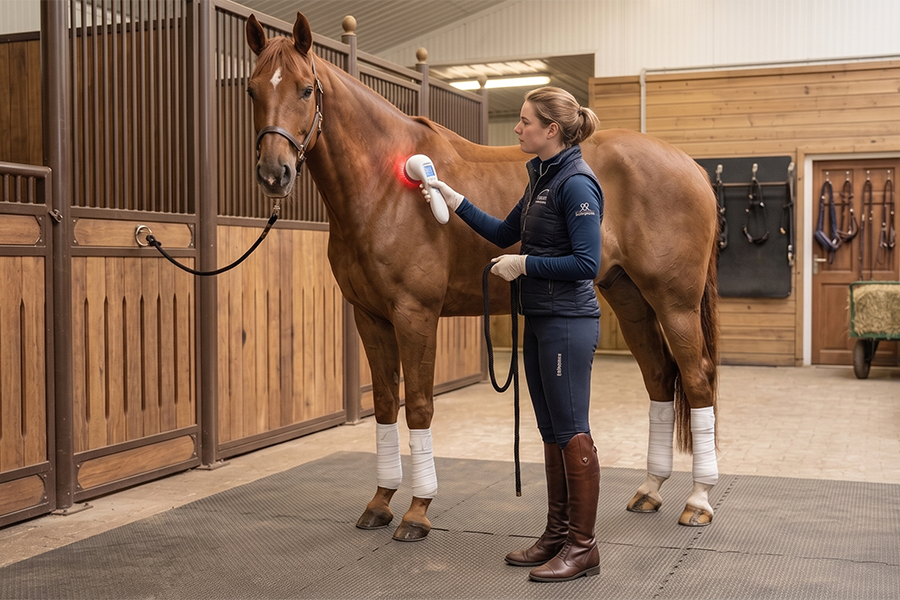
The Healix Questrian Pro system represents this evolution in equine care. Released as a Class 3B laser therapy device, it delivers 1300mW of total output power across multiple therapeutic wavelengths (905nm at 75W peak, 850nm at 100mW, 635nm at 180mW total, and 470nm at 100mW total) designed specifically for equine applications. The device’s twelve pre-programmed protocols address common performance horse conditions through photobiomodulation – the process where specific light wavelengths stimulate cellular healing responses.
Unlike passive rest, which simply removes stress from affected tissues, therapeutic laser application actively supports cellular processes including ATP production, increased circulation, and reduced inflammation markers. This distinction becomes critical when dealing with the five warning signs detailed below.
The Pattern to Watch For
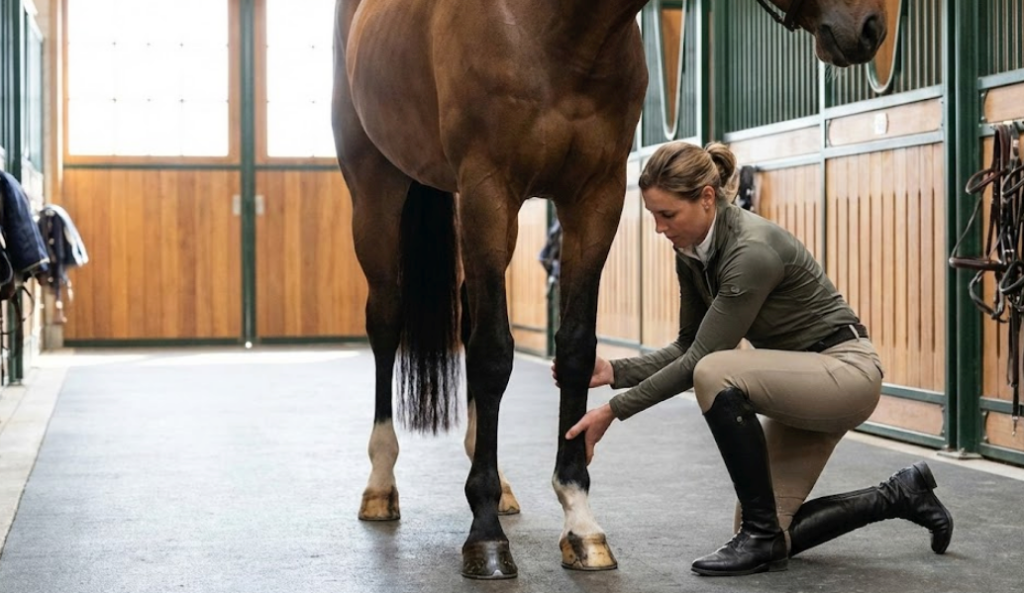
Your horse performs well some days but shows reluctance, resistance, or reduced performance on others despite consistent training schedules and adequate recovery time between sessions. This inconsistency often indicates underlying tissue stress that rest periods aren’t adequately addressing.
Veterinary research published in equine sports medicine journals indicates that inconsistent performance frequently correlates with subclinical joint inflammation – tissue changes present before obvious lameness appears. These changes accumulate over time, creating a cycle where inflammation reduces performance, rest provides temporary relief, but the underlying condition remains unresolved.
Why Rest Alone Falls Short
Joint inflammation involves complex biochemical processes that passive rest doesn’t directly address. While rest prevents additional stress, it doesn’t actively support the resolution of existing inflammatory markers or promote tissue repair processes.
The Healix Questrian Pro’s approach differs through its hock-specific protocol, a five-minute treatment program designed for joint applications. The multi-wavelength delivery targets different tissue depths – the 905nm wavelength (delivering peak power of 75W in pulsed mode) penetrates deeply to reach joint structures, while the 635nm and 470nm wavelengths address superficial inflammation and circulation.
According to the Healix Questrian Pro user manual, the hock protocol operates at specific frequencies (5Hz, 500Hz, 2500Hz) with varied watt outputs (5W, 7W, 7W, 7W across four sequential phases) and treatment durations (60, 30, 30, 30 seconds respectively). This precise parameter control aims to optimize cellular response at different tissue levels.
Implementation Approach
For horses showing inconsistent performance, the documented treatment approach involves:
Assessment Phase:
- Professional veterinary examination to rule out acute injuries
- Identification of specific affected joints or areas
- Baseline performance documentation
Treatment Protocol:
- Daily treatments during the initial week using appropriate joint-specific protocols
- Transition to maintenance schedule (typically 3-4 times weekly)
- Continued performance monitoring to track response
The Healix system’s treatment tracking feature allows documentation of each session, helping identify patterns between treatment frequency and performance consistency.
Learn more about the Healix Questrian Pro’s specialized protocols
Sign #2: Chronic Stiffness That Worsens with Weather Changes
Recognizing the Pattern
Many horse owners notice their animals show increased stiffness during cold, damp weather or take longer to “warm up” before achieving normal movement quality. While some stiffness with weather changes is common, pronounced or worsening patterns suggest chronic soft tissue changes requiring active intervention.
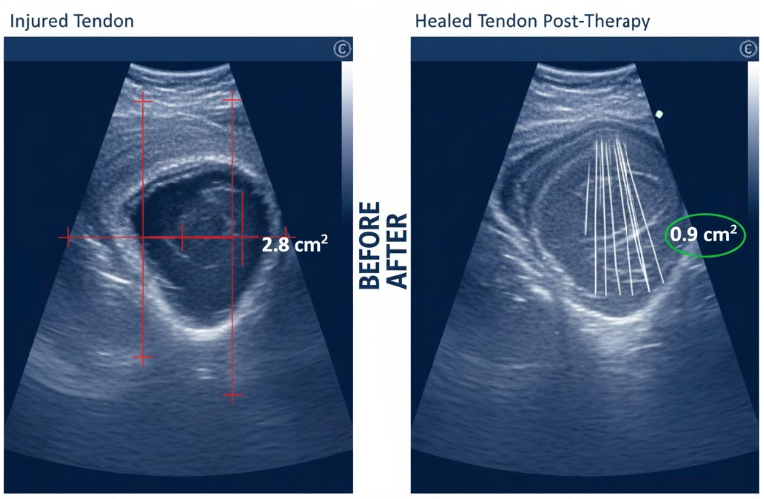
Research in equine musculoskeletal conditions indicates that weather-related stiffness often correlates with chronic soft tissue restriction – scar tissue formation, fascial restrictions, or persistent muscle tension that passive rest doesn’t resolve and may actually worsen during inactivity.
The Therapeutic Approach
The Healix Questrian Pro addresses soft tissue conditions through its dedicated “Tendons & Ligaments” protocol, a four-minute treatment program specifically calibrated for these structures. According to the device specifications, this protocol delivers sequential treatments at 1000Hz, 2500Hz, 5000Hz, and 500Hz frequencies, with power outputs of 4W across all phases and 30-second durations per phase.
This multi-frequency approach reflects research into how different cellular structures respond to varied energy delivery patterns. Tendon cells and ligament fibroblasts – the cells responsible for tissue structure and repair – show different optimal response frequencies than other tissue types.
Documented Implementation
Professional facilities implementing laser therapy for chronic soft tissue stiffness typically follow this documented approach:
Initial Phase (Weeks 1-2):
- Daily treatments to affected areas
- Pre-treatment and post-treatment range of motion assessment
- Documentation of “warm-up” time required for normal movement
Transition Phase (Weeks 3-4):
- Reduce to 4-5 treatments weekly
- Begin controlled exercise progression
- Continue monitoring stiffness patterns
Maintenance Phase (Ongoing):
- Treatments 2-3 times weekly
- Adjusted based on workload and weather patterns
- Integrated with regular training schedule
The Healix Questrian Pro’s portability (270g weight, 5000mAh battery providing 4-5 hours operation) allows treatment in the horse’s regular environment, reducing stress and allowing observation of movement quality in familiar surroundings.
Sign #3: Recurring Problems in the Same Location
The Warning Sign
When the same leg, joint, or area repeatedly develops issues despite proper rest periods between incidents, it signals that the underlying tissue hasn’t fully recovered or has developed chronic changes making it vulnerable to re-injury.
Equine veterinary literature identifies this pattern as a primary indicator of incomplete healing or compensatory strain patterns. Once tissue sustains injury, it often heals with altered biomechanical properties. Without intervention supporting optimal tissue remodeling, these areas remain predisposed to repeated problems.
Addressing Recurring Issues
The Healix Questrian Pro system includes specific protocols for common recurring problem areas:
Back & Shoulders Protocol (4 minutes):
- Frequencies: 500Hz, 1000Hz, 5000Hz
- Power outputs: 8W across all phases
- Phase durations: 60, 30, 30, 30 seconds
- Designed for large muscle groups and complex joint areas
Stifles Protocol (4 minutes):
- Frequencies: 5Hz, 2500Hz, 500Hz
- Power outputs: 7W across phases
- Phase durations: 60, 30, 30, 30 seconds
- Targets the complex stifle joint structure
Feet Protocol (4 minutes):
- Frequencies: 500Hz, 1000Hz, 2500Hz
- Power outputs: 4W across phases
- Duration: 30 seconds per phase
- Addresses lower limb and hoof-related issues
Each protocol’s specific parameters reflect different anatomical considerations – deeper tissue structures require different energy delivery than superficial areas, and complex joints benefit from varied frequency patterns that address multiple tissue types simultaneously.
Treatment Strategy
For recurring issues, the documented approach emphasizes:
Initial Assessment:
- Veterinary examination to identify contributing factors
- Biomechanical assessment to identify compensatory patterns
- Detailed documentation of previous injury history
Active Treatment Phase:
- Daily treatments to affected area using appropriate protocol
- Concurrent addressing of compensatory areas (opposite limb, back)
- Progressive introduction of controlled movement
Prevention Protocol:
- Continued treatments during increased training loads
- Pre-competition preparation using relevant protocols
- Post-event recovery treatments
The Healix system’s multiple wavelengths prove particularly relevant for recurring issues. The 905nm wavelength (75W peak output in pulsed mode) penetrates to deep tissue structures where chronic changes often originate, while the 850nm (100mW), 635nm (180mW total), and 470nm (100mW total) wavelengths address progressively more superficial tissue layers.
Sign #4: Reduced Range of Motion Not Improving with Exercise
Identifying the Problem
Normal range of motion typically improves as horses warm up during exercise. However, persistent restrictions that don’t improve with movement suggest structural tissue changes – capsular restrictions, adhesions, or chronic inflammation limiting normal joint mechanics.
Published research in equine rehabilitation indicates that passive rest often allows these restrictions to worsen as tissues heal in shortened positions or adhesions form between tissue planes that should move independently.
The Therapeutic Response
Range of motion restrictions require active intervention supporting tissue extensibility and normal biomechanics. The Healix Questrian Pro approaches this through protocols designed for specific joint complexes:
Knees & Fetlocks Protocol (5 minutes):
- Frequencies: 5Hz, 500Hz, 2500Hz
- Power sequence: 5W across phases
- Duration sequence: 60, 30, 30, 30 seconds
- Targets complex lower limb mechanics
This protocol’s specific parameters address the unique challenges of lower limb range of motion. The initial 60-second phase at 5Hz provides sustained energy delivery to deeper capsular structures, while subsequent higher-frequency phases address superficial restrictions and circulation.
Documented Implementation Approach
Professional implementation for range of motion issues follows this pattern:
Baseline Phase:
- Detailed range of motion measurements at multiple joints
- Documentation with photo or video for comparison
- Identification of movement restrictions
Intensive Treatment Phase (2-3 weeks):
- Treatments 5-6 times weekly
- Pre-treatment and post-treatment range of motion assessment
- Gentle stretching 20-30 minutes post-treatment
- Progressive loading as range improves
Maintenance Phase:
- Reduce to 3-4 treatments weekly
- Continue monitoring range of motion metrics
- Adjust treatment frequency based on work intensity
The Class 3B classification of the Healix Questrian Pro provides therapeutic benefits while maintaining a safety profile appropriate for regular use in barn environments. The device includes built-in safety features including automatic treatment timers and power monitoring.
Understanding therapeutic laser technology for large animals
Sign #5: Extended Recovery Time After Normal Work
The Critical Pattern
When your horse requires progressively longer recovery periods after workloads they previously handled easily, or when routine training sessions leave them sore for days rather than hours, it signals that natural recovery processes aren’t keeping pace with demands.
Equine sports medicine research identifies this pattern as one of the earliest indicators of developing chronic issues. The cumulative stress of training exceeds the body’s natural repair capacity, leading to micro-damage accumulation that passive rest alone cannot adequately address.
The Healix Approach
The Healix Questrian Pro system addresses recovery challenges through two specialized protocols:
Muscle Fatigue Protocol (8 minutes):
- Frequencies: 60Hz, 500Hz, 1000Hz, 2500Hz
- Power outputs: 6W across all phases
- Extended duration: 60 seconds per phase
- Designed specifically for muscle recovery after exertion
This protocol’s extended treatment time (8 minutes versus the typical 4-5 minutes of other protocols) reflects the different metabolic needs of muscle recovery. The varied frequency progression addresses multiple aspects of muscle fatigue – from lactate clearance to cellular energy restoration.
Soft Tissue Injuries Protocol (4 minutes):
- Frequencies: 500Hz, 1000Hz, 2500Hz, 5000Hz
- Power outputs: 6W across phases
- Duration: 30 seconds per phase
- Supports recovery from minor training-related tissue stress
Implementation for Recovery Support
Professional facilities using laser therapy for performance recovery typically implement this approach:
Post-Work Protocol:
- Treatment within 2-4 hours after training or competition
- Focus on primary work areas (back, hindquarters for jumpers; specific limbs for eventers)
- 8-minute muscle fatigue protocol for heavily worked areas
- Documentation of recovery time to next work session
Recovery Monitoring:
- Tracking time to return to normal movement quality
- Comparing recovery periods with and without laser therapy
- Adjusting treatment frequency based on training intensity
Competition Schedule Integration:
- Pre-competition treatments (24-48 hours before)
- Post-competition recovery protocol
- Maintenance treatments during competition season
The portable design of the Healix Questrian Pro (270g, professional carrying case included) makes this integration practical even during travel to competitions or training facilities.
Critical Safety Considerations
Class 3B Laser Safety Requirements
The Healix Questrian Pro is classified as a Class 3B laser product, which requires specific safety protocols during operation. According to the device user manual and laser safety standards:
Mandatory Requirements:
- Wavelength-specific laser safety eyewear must be worn by the operator
- Eye protection required for anyone within the treatment area
- Never direct the laser beam toward eyes
- Keep device out of reach of children
- Post laser warning signs during operation
Operating Environment:
- Temperature range: 5-30°C (41-86°F)
- Clean, well-ventilated area
- Avoid flammable environments
- Do not use device if wet or in rain
Contraindications:
- Avoid use over eyes or suspected malignancies
- Not for use on pregnant mares
- Professional veterinary consultation recommended before starting treatment
The Class 3B classification means the device delivers therapeutic benefit while maintaining appropriate safety margins when used according to manufacturer guidelines. All safety information is detailed in the comprehensive user manual included with every Healix Questrian Pro system.
When to Seek Veterinary Consultation
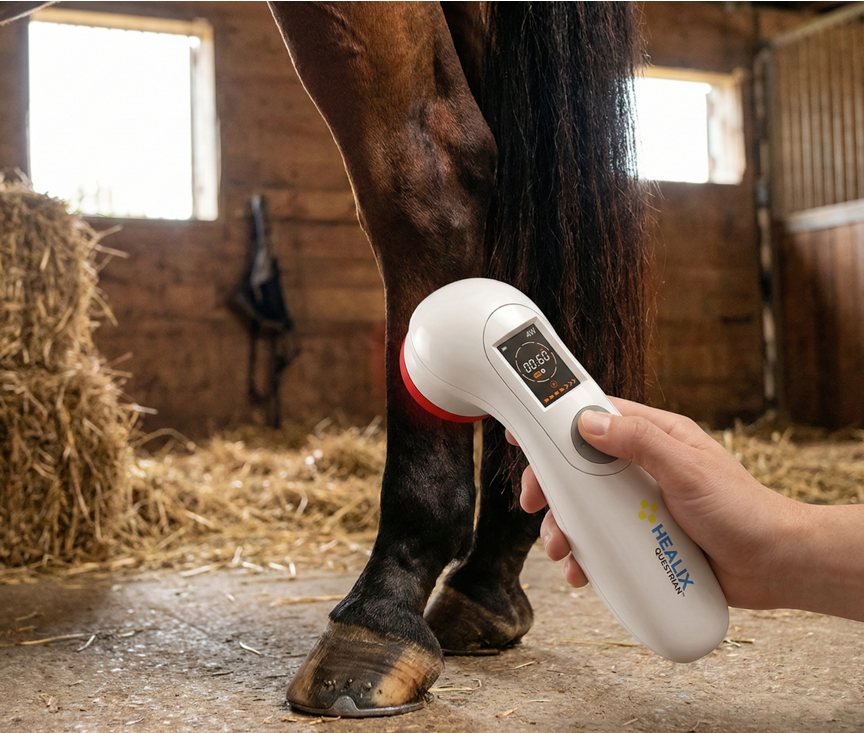
While therapeutic laser therapy supports recovery and maintenance care, certain situations require immediate veterinary attention:
Seek Veterinary Care Immediately For:
- Obvious lameness or non-weight bearing
- Acute swelling, heat, or pain
- Sudden behavior changes or distress
- Any suspected fracture or severe injury
- Wounds requiring medical attention
Laser therapy functions as a complementary approach alongside proper veterinary diagnosis and care. The Healix Questrian Pro supports ongoing management of diagnosed conditions and performance maintenance but does not replace professional veterinary medicine.
Practical Implementation: Getting Started
Initial Setup
The Healix Questrian Pro arrives ready to use with minimal setup required:
Package Contents:
- Healix Questrian Pro device (270g)
- Heavy-duty carrying case
- USB-C charging cable and power adapter
- Comprehensive user manual
- Quick start guide
- Access to online product videos
First Steps:
- Charge device fully (approximately 3 hours initial charge)
- Review user manual safety guidelines
- Familiarize yourself with the 12 pre-programmed protocols
- Practice operation without applying to horse initially
Creating Your Treatment Routine
Successful integration into your horse care routine follows this pattern:
Week 1-2: Establishment Phase
- Begin with one treatment daily on identified problem area
- Use appropriate protocol based on condition
- Document treatment time, protocol used, and observations
- Monitor horse’s response over 24-48 hours
Week 3-4: Adjustment Phase
- Adjust frequency based on observed response
- May increase to treating multiple areas if needed
- Establish consistent treatment schedule
- Continue detailed documentation
Ongoing: Maintenance Phase
- Maintain 2-3 treatments weekly for chronic conditions
- Increase frequency during competition season
- Integrate with training schedule
- Regular assessment of progress
The device’s LED screen clearly displays treatment time remaining, making it easy to complete full protocols without interruption. The preset programs eliminate guesswork about appropriate power levels and treatment duration for different conditions.
Understanding Treatment Response
What to Expect
Individual horses respond differently to laser therapy based on multiple factors including condition severity, age, overall health, and consistency of treatment. Understanding typical response patterns helps set realistic expectations:
Acute Conditions:
- May show improvement after 3-4 treatments
- Faster response to daily treatment protocol
- Clear progress indicators (reduced heat, improved movement)
Chronic Conditions:
- Typically require 2-3 weeks of consistent treatment
- More gradual improvement
- Benefits from long-term maintenance schedule
Performance Maintenance:
- Supports consistent performance quality
- Reduces recovery time between training sessions
- Most effective when integrated into regular routine
Monitoring Progress
Effective treatment requires objective monitoring rather than subjective impressions:
Measurable Indicators:
- Time required to warm up to normal movement
- Consistency of performance between sessions
- Recovery time after work
- Range of motion measurements
- Heat and swelling in affected areas
- Veterinary assessment findings
The Healix system’s treatment tracking helps identify correlations between treatment frequency and observable improvements, allowing protocol adjustments based on individual response.
Cost-Effectiveness Analysis
Investment Considerations
At $2,499, the Healix Questrian Pro represents a significant investment that horse owners should evaluate based on their specific circumstances:
Potential Value Factors:
- Reduced veterinary costs for ongoing management
- Decreased medication requirements
- Shorter recovery periods reducing training interruption
- Extended competitive career through better maintenance
- Convenience of home treatment versus facility visits
Example Scenario: For a horse requiring ongoing joint management, typical costs might include:
- Monthly veterinary visits: $150-300
- Injectable joint treatments: $200-500 per treatment
- Transportation to facilities: $50-100 per trip
- Lost training time during treatment recovery
With the Healix Questrian Pro, owners can provide consistent supportive care at home, potentially reducing the frequency of more invasive interventions. Financing options starting at $208/month make the investment more accessible.
When It Makes Sense
The Healix Questrian Pro provides greatest value for:
- Horses with chronic conditions requiring ongoing management
- Performance horses with high training demands
- Multiple horses in a single facility
- Situations where frequent facility visits prove challenging
- Owners committed to proactive maintenance care
Frequently Asked Questions
Q: How quickly should I expect to see improvements in my horse?
Response timelines vary by condition. Acute issues may show improvement within 3-4 treatments, while chronic conditions typically require 2-3 weeks of consistent daily treatment. The key is establishing baseline measurements and tracking objective changes rather than relying on subjective impressions.
Q: Can I use the device on multiple horses?
Yes, the Healix Questrian Pro can safely treat multiple horses. Clean the treatment window between animals following guidelines in the user manual. The device’s 4-5 hour battery life supports treating several horses per charge, making it practical for multi-horse facilities.
Q: What’s the difference between this and lower-powered laser devices?
The Healix Questrian Pro’s Class 3B classification with 1300mW total output power provides greater tissue penetration than lower-powered devices. The multi-wavelength approach (905nm, 850nm, 635nm, 470nm) targets different tissue depths simultaneously, while the 12 pre-programmed protocols optimize delivery for specific equine conditions.
Q: Do I still need veterinary care if using laser therapy?
Absolutely. Laser therapy supports ongoing management and maintenance but doesn’t replace proper veterinary diagnosis and care. Always consult your veterinarian for new conditions, acute injuries, or changes in your horse’s condition. The Healix system works best as part of comprehensive veterinary care.
Q: How long does each treatment session take?
Treatment duration depends on the protocol selected. Most Healix Questrian Pro protocols run 4-5 minutes per area, with the muscle fatigue protocol extending to 8 minutes. Multiple areas can be treated in a single session, with total time adjusted based on your horse’s needs and tolerance.
Taking Action: Your Next Steps
The five warning signs detailed in this guide – inconsistent performance, chronic stiffness, recurring problems, reduced range of motion, and extended recovery times – all indicate that your horse needs more than passive rest to address underlying issues.
Modern therapeutic approaches like the Healix Questrian Pro system provide horse owners with tools previously available only through professional veterinary facilities. The combination of multi-wavelength technology, condition-specific protocols, and portable design makes proactive care practical in everyday barn environments.
Recommended First Steps:
- Document Current Condition: Take detailed notes and photos of any problem areas, movement restrictions, or performance issues you’ve observed.
- Veterinary Consultation: Schedule professional evaluation to rule out serious injuries and establish baseline condition assessment.
- Evaluate Treatment Options: Consider whether your horse’s conditions and your management situation make therapeutic laser therapy a practical addition to your care routine.
- Learn More: Visit the Healix Questrian Pro product page to review detailed specifications, protocol information, and technical support resources.
The difference between a minor setback and a career-ending problem often lies in early recognition and appropriate intervention. Don’t wait until obvious lameness appears – address the warning signs before they progress.
Explore the Healix Questrian Pro System →
Contact Healix Support for Questions →
Phone: 888-778-9933
This article references publicly available information from Healix Technologies, Inc., including the Healix Questrian Pro Pulse user manual and product specifications. All technical details, protocols, and safety information are from documented sources. Results described represent typical patterns observed in equine therapeutic applications and may vary based on individual horse health, condition severity, and treatment consistency. For current product information, consult www.healixlasers.com. Always consult qualified veterinary professionals for diagnosis and treatment recommendations.
Educational content only, not a veterinary diagnosis or treatment recommendation. Your veterinarian should assess your horse and guide any care plan.