
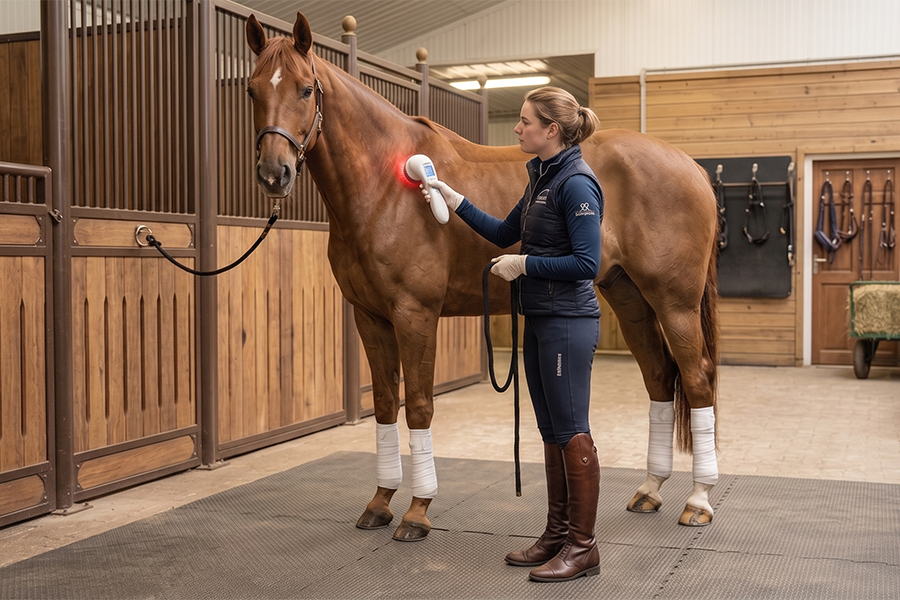
A 2020 study published in Frontiers in Veterinary Science tracked 12 Warmblood horses with standardized suspensory ligament lesions. Limbs treated daily with high-power laser therapy for four weeks showed significantly smaller lesions on MRI two to three months later than untreated limbs. For performance horse owners facing months of downtime from a single tendon injury, that difference is the gap between making the next season and missing it.
What Slow Recovery Actually Costs
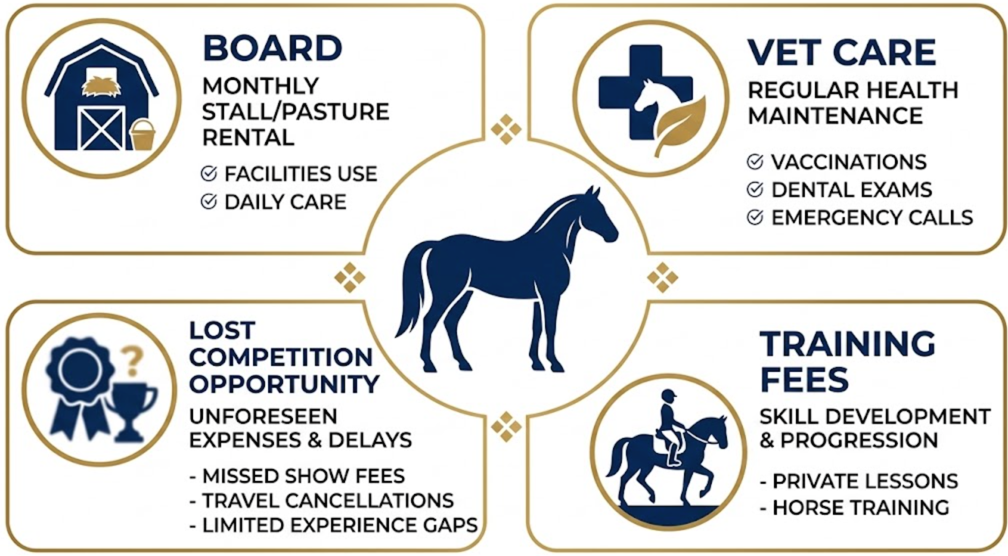
Soft tissue injury is not a rare event in performance horses. Research published in the Journal of Equine Veterinary Science found that soft tissue injuries to tendons or ligaments account for roughly 13–18% of horses needing rest and time off, and are responsible for about 33% of training losses in non-elite performance horses.
The real cost is not one bill. It’s the compounding of every category at once: continued boarding, ongoing veterinary diagnostics and treatment, rehab exercise work, and competition opportunities that pass the horse by while tissue remodels.
None of that accounts for the biggest hidden cost — recurrence. Published reviews in the Journal of Equine Veterinary Science documented that after superficial digital flexor tendon (SDFT) injuries, only 20–60% of Thoroughbreds return to racing, and re-injury rates reach nearly 80% in horses pushed back too quickly. Tendonitis forces roughly 25% of racehorses into retirement, making it the most common non-fatal career-ending injury.
Why Slow Recovery Happens — The Biology Behind It
When a tendon or ligament tears, healing moves through three documented phases: inflammation (3–7 days, peaking at 24–48 hours), proliferation, and remodeling. The full remodeling phase for tendonitis can take approximately 16 months, according to tendon recovery research cited across multiple veterinary literature reviews.
Healed tendon tissue does not regain its original mechanical properties because scar tissue disrupts the natural fascicle alignment. This is why horses returning to work after tendonitis have elevated recurrence rates — the repaired tissue is structurally weaker than what was lost.
Every week of slow healing means another week of stall maintenance, supplements, farrier trims, and missed competition — plus continued risk of re-injury if the horse returns before remodeling is complete.
How Healix Designed the Questrian for This Specific Problem
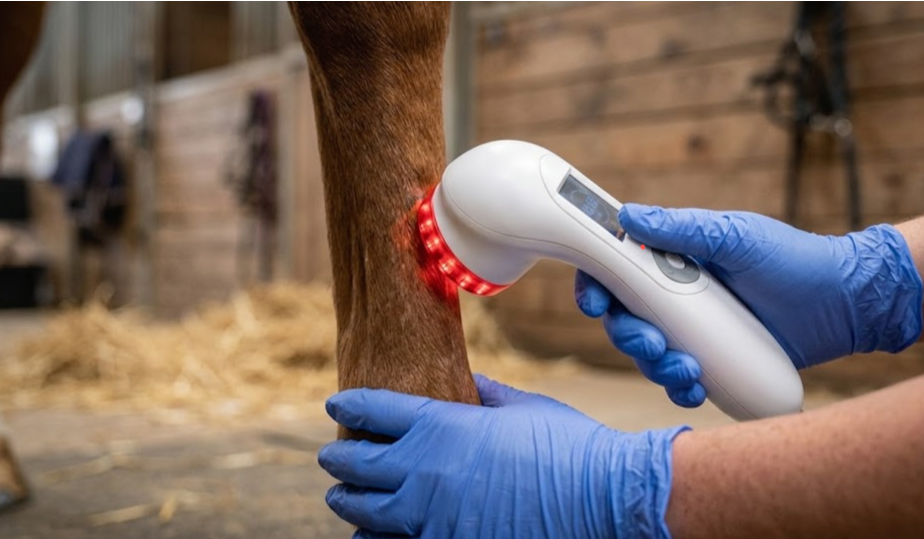
Healix Lasers, based in Scottsdale, Arizona, developed the Healix Questrian as a professional-grade equine laser therapy device targeted at the soft tissue recovery window. Published technical specifications from the company include:
- 75W total system output
- Four therapeutic wavelengths: 905nm, 850nm, 635nm, and 470nm
- 12 pre-programmed equine protocols covering feet, hocks, tendons and ligaments, contaminated wounds, edema and congestion, shins and fractures (continuous wave), plus clean wounds, muscle fatigue, soft tissue injuries, back and shoulders, stifles, and knees and fetlocks (pulsed)
- FDA-cleared, CE certified, ISO 13485 and ISO 9001 certified
- 270g handheld, barn-ready design with a 5000mAh lithium battery delivering 4–5 hours of continuous use
The rationale behind those four wavelengths is tissue-depth targeting. The 905nm and 850nm wavelengths reach deeper tendon and ligament structures; 635nm supports superficial soft tissue and wound healing; 470nm addresses surface bacterial load in contaminated wounds.
Verified purchaser Dr. James L., DVM, sports medicine specialist, wrote on December 9, 2024: “As an equine veterinarian, I recommend the Questrian to my clients for ongoing care. The results in post-competition recovery are remarkable.” Professional dressage trainer Sarah M. added on the same date: “The Questrian has become an essential part of our competition preparation.”
Measurable Outcomes from Published Research
The strongest evidence for laser therapy in equine soft tissue recovery comes from peer-reviewed studies Healix Lasers references on their educational pages.
The Pluim retrospective study (150 sport horses): A retrospective clinical study on 150 sport horses with tendinopathy and desmopathy of the SDFT, DDFT, suspensory ligament, and suspensory branches documented significant improvement in lameness and ultrasound scores beginning two weeks after initiation of high-power laser therapy. Re-injury rates were 16.8% at 6 months, 21.0% at 12 months, and 18.2% at 24 months — within the lower end of published ranges for competing treatments.
The Pluim 2020 controlled study: In the standardized lesion model published in Frontiers in Veterinary Science, 12 Warmblood horses each received four induced lesions on the lateral suspensory ligament branches. Two per horse were treated daily with multi-frequency high-power laser for four weeks. Two to three months post-treatment, lesion cross-sectional area on MRI was significantly smaller in laser-treated lesions than in control lesions.
A separate High Intensity Laser Therapy (HILT) study on performance horses with tendon and ligament injuries reported significant improvements in pain (p = 0.023), swelling (p = 0.008), lameness (p = 0.044), and lesion percentage reduction (p = 0.019) in treated horses versus controls across a 40-day rehabilitation period with 15 HILT sessions.
A cited 904nm case series found approximately 97% of horses with tendon and ligament injuries regained soundness after laser therapy, with roughly 90% still performing well 1–2 years later, per clinical data referenced on Healix Lasers’ educational pages.
One honest trade-off: laser therapy requires a committed treatment program. Published data shows roughly 14–28 sessions over several weeks are typical, and the World Association for Laser Therapy (WALT) recommends daily treatment for approximately two weeks, or every other day for 3–4 weeks, for tendon injuries. This is a reason to own the device rather than schedule every session as a clinic visit.
How Different Organizations Approach the Same Problem
Academic research institutions — reflected in the Pluim studies — focus on controlled lesion models and ultrasound-confirmed outcomes, validating the biological mechanism under laboratory conditions.
Sport horse veterinary practices represented in the 150-horse retrospective study applied laser therapy in clinical rotation alongside controlled exercise and cold hydrotherapy, tracking re-injury at 6, 12, and 24 months as the primary outcome.
Private barns and professional trainers, represented in Healix’s verified testimonials, integrate laser into daily performance maintenance — using pre-programmed protocols for consistency across multiple horses without requiring advanced veterinary training on site.
The Questrian is designed to bridge those groups: clinical-grade power delivered through preset protocols simple enough for barn use, cleared to the same regulatory standards as clinical-only devices.
Practical Implementation Guide
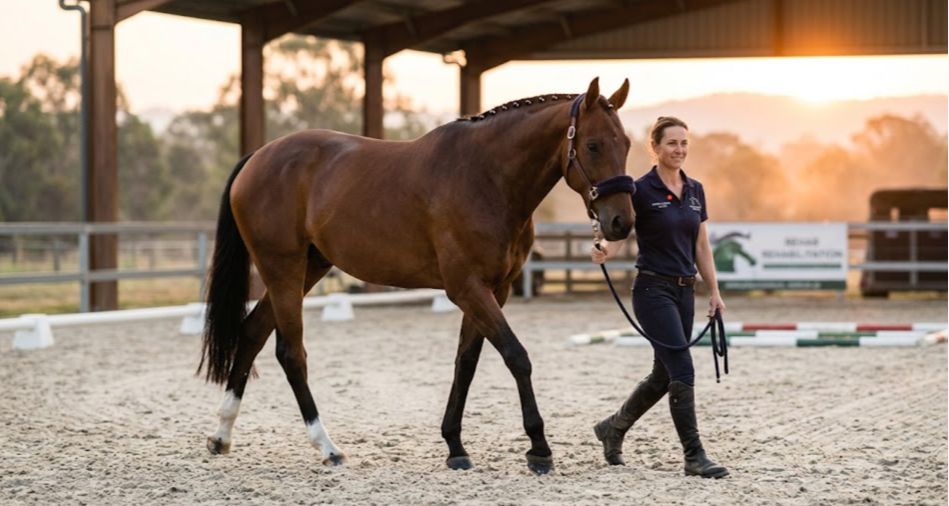
Based on published methodology from the peer-reviewed studies and Healix’s own protocol guidance:
- Get a veterinary diagnosis first. Every published laser therapy study starts with ultrasound- or MRI-confirmed lesion measurement. Without that baseline, you cannot measure progress.
- Match protocol frequency to lesion phase. Acute desmitis: daily sessions for the first two weeks per WALT guidelines. Subacute or chronic lesions: every other day for 3–4 weeks.
- Plan for 14–28 total sessions. The Pluim 2020 study used daily 20-minute sessions for four weeks. The HILT tendon study used 15 sessions over 40 days.
- Pair laser therapy with controlled exercise. Every study cited combined laser with structured walking, cold hydrotherapy, and graduated return-to-work — laser accelerates healing but does not replace rehabilitation.
- Re-scan at intervals. Published protocols re-ultrasound before treatment, mid-treatment, and post-treatment to confirm lesion reduction before escalating workload.
- Do not shortcut return-to-work. High re-injury rates come from horses pushed back before tissue remodeling completes.
Conclusion
The 2020 Warmblood suspensory study that opened this article showed measurable MRI-confirmed lesion reduction from four weeks of daily high-power laser therapy. Measured against the documented cost of slow recovery — long remodeling timelines, continued expenses across every care category, and elevated re-injury risk — the case for daily accelerated therapy becomes straightforward.
Your next step: Talk to your veterinarian about whether the Healix professional-grade Questrian laser system fits your horse’s specific diagnosis and rehabilitation plan. Review the published research on laser therapy for equine suspensory ligament injuries and bring the Pluim studies to your next vet appointment.
FAQ Section
How quickly can laser therapy shorten recovery in performance horses?
The Pluim 150-horse retrospective study showed significant lameness and ultrasound improvements beginning two weeks after starting high-power laser therapy. The Horse magazine reports some horses returned to previous performance levels in four to six months.
Is laser therapy safe for my horse?
Per Healix Lasers’ product documentation, the FDA-cleared Questrian has no known side effects when used per protocol. A 2024 HILT study on 21 Thoroughbreds confirmed no adverse reactions during treatment.
How many laser sessions does a tendon injury typically need?
Published studies used 14–28 sessions. WALT guidelines recommend daily treatment for two weeks or every other day for 3–4 weeks. The Pluim 2020 protocol was daily 20-minute sessions for four weeks.
Can I use the Questrian myself, or does a vet need to operate it?
The Questrian is designed with 12 preset equine protocols and an LCD interface for barn use. Healix recommends veterinary diagnosis first, then owner-administered treatment under a vet-approved rehabilitation plan.
Does laser therapy replace rest and rehabilitation exercise?
No. Every published study combined laser with structured walking, cold hydrotherapy, and graduated return-to-work. Laser accelerates the natural healing process rather than bypassing it.
This article references publicly available information from Healix Lasers, Frontiers in Veterinary Science (Pluim et al. 2020), the Journal of Equine Veterinary Science, The Horse magazine, and the World Association for Laser Therapy (WALT), dated 2018 through 2026. All metrics and quotes are from documented sources including peer-reviewed studies, company product specifications, and verified customer reviews dated December 9, 2024. Results described are specific to the horses and organizations mentioned and may vary based on individual diagnosis, injury severity, rehabilitation compliance, and implementation approach. For current product specifications or clinical guidance, consult healixlasers.com and your licensed equine veterinarian.
 888-511-1553